
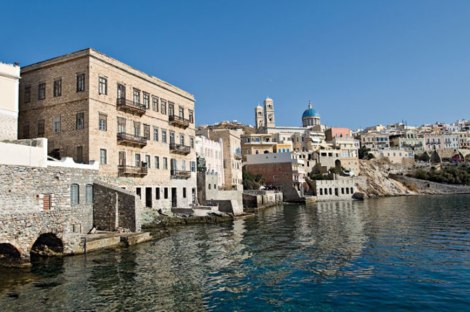
Pictured: Ermoupolis, the chief town of Syros and all of the Cyclades
The island of Santorini is famous for its beauty and its sophisticated hotels, but as Rachel Howard reveals, other islands in the Cyclades have different attractions.Which of these Aegean idylls is for you?
James Theodore Bent, the intrepid British scholar who toured the Cyclades in the 1880s, pronounced Santorini ‘a hideous island, fascinating in its hideousness’. Today, the most famous of all Greek islands is renowned for its ravishing beauty. However, if you fly into Santorini, your first impressions might lean towards Bent’s school of thought. Unsightly buildings pockmark the landscape. It is only when you catch sight of the caldera – the flooded crater created by a volcanic eruption 3,500 years ago – that you will appreciate why this is one of the world’s top honeymoon destinations.
‘It’s what the Americans call the million-dollar view,’ says Joseph Gaoutsis, co-manager of the Grace Santorini hotel. This isn’t just a turn of phrase. An acre of land on the caldera costs more than a million euros. Ironically, land on this part of the island was traditionally given to the black sheep of the family because the sheer, windswept cliffs couldn’t be cultivated with vines or cherry tomatoes (the cornerstones of the local economy before tourism). Now these rogues are millionaires. Thankfully, building regulations along the caldera are tight, so there’s nothing to mar the mindblowing view.
Some of Greece’s finest (and priciest) hotels are lined up along the caldera, mainly in the pretty village of Oia, marooned on the island’s northern tip, and the black sand beaches are no match for the infinity pools spilling over the edge of the abyss. It’s not the grand captains’ houses but their crews’ humble cave dwellings, burrowed into the cliff, that have been converted into five-star lodgings. The lowliest sailors were relegated to the lower rungs of the rock face – still something to watch out for when booking your hotel room. Santorini is not for the unfit or those protective of their personal space. Rooms are tightly stacked, so you can check out who has the biggest plunge pool or bikini collection. Serious voyeurs even bring binoculars.
Joseph leads us down the vertiginous path to Grace Santorini. The hotel and surrounding village of Imerovigli teeter on the brink of the cliff. Here, cooing couples are smearing each other in suncream by the pool so, feeling self-conscious, I set off to climb Skaros, a rocky outcrop that was once the island’s capital. It’s like stepping inside a View-Master: a widescreen panorama of streaky black and red cliffs, crested by whitewashed houses which look like seagulls poised for flight. The charred islets of Palea Kameni and Nea Kameni – ominous remains of the volcano – sizzle in the glassy sea. There were once 200 houses on Skaros. An enormous bell rang out whenever a pirate ship appeared on the horizon. Now the cruise ships drifting into the caldera send ripples of anticipation rather than alarm through the entrepreneurs waiting on shore.
As dusk falls, coachloads of excitable tourists jostle for space along the ruins of Oia’s Venetian castle to watch the sun slip into the sea. A firing squad of zoom lenses take aim. A bride in improbably high heels appears on a donkey. I slink off to savour the sunset with a glass of Assyrtiko at the Sigalas winery.
Not so long ago, Paris Sigalas was the local maths teacher. Now he’s an award-winning vintner who, over the past decade, has helped put Santorini back on the map as a world-class wine destination. The island’s volcanic terroir has been cultivated with vines for thousands of years, and in the 19th century, ship-owners made fortunes exporting sweet Vin Santo to the Black Sea and beyond. But the schooners that set sail for Odessa are long gone. In their place are a handful of fishing boats that provide the catch of the day to the waterfront tavernas at Ammoudi, the harbour that lies 200-odd zigzagging steps below Oia. A haul of bream arrives just in time for my supper.
At first light, I catch the ferry to Folegandros, an island ‘where the steamer does not touch, and where sometimes in winter they are weeks without a post’, James Theodore Bent observed in 1885. Surprisingly little has changed. Folegandros is on the ‘agoni grammi‘, the unprofitable line; one of several remote islands serviced infrequently by state-subsidised ferry routes. Recent allegations of officials demanding bribes in return for licences to run these routes have not shamed the government into improving the service. The only ferry from Santorini in May when I am there is the Aeolos Kenteris, unfortunately named both after the God of Wind and Greek sprinter Kostas Kenteris, disqualified from the Athens Olympics on dope charges. There’s no question of performance-enhancing drugs today: the 25-mile journey takes four hours (there are more frequent, but still erratic services in July and August).
‘Of all the islands of the Aegean Sea, Pholygandros can boast of the most majestic coastline… I doubt if it can be equalled anywhere,’ Bent declared. I’m inclined to agree. The main village, Chora, is huddled atop a jagged cliff. It’s a 200-metre plunge to the sea, but the emerald water is so translucent that you can count the fish swimming by. The same pale-green stones that give the sea its limpidity pave Chora’s tangle of lanes, which all lead eventually to three interlocked squares lined with trees, tavernas and bite-sized bars. Locals knock back shots of rakomelo, warm raki with honey that glazes the world in a fuzzy glow. In the Kastro – the fortified, medieval castle – children scamper among billows of crimson geraniums.
Folegandros has around 650 inhabitants. There’s no bank and only one ATM. The north of the island still has no electricity. When the first hotel, Fani Vevis, opened in the early 1970s there was only one bathroom for all 12 rooms. ‘Water was so scarce that the shower cost 70 drachmas, although rooms were only 10 drachmas,’ recalls Fani Anastasiadi, who still runs the hotel, which was set up by her grandparents. ‘Tourists would line up outside the bathroom in their towels and wait their turn. My grandmother would yell at them to turn off the taps,’ she says.
The ancient Greeks called the island Folegandros, or ‘iron hard’, because of its unforgiving terrain. Perhaps that’s why political exiles were dispatched here for centuries. Stoical locals tamed the valleys with slate terraces, coaxing crops from the scorched, sun-baked earth. Most farmsteads are scattered around Ano Meria in the north. Donkeys work hard here – they’re not just a photo opportunity. Lemon trees are protected from fierce winds by circular stone dendrospita (‘tree-houses’). The village bakery is fired with brushwood, which gives the kouloures (rusks flavoured with aniseed) and kalasouna (goat’s cheese and onion pie) a wonderful smoky aroma.
There is a bus service from Chora to Ano Meria, but when I check the chalkboard timetable it’s blank. Folegandros runs on GMT: Greek Maybe Time. But step onto the road and within moments someone will offer you a lift. Or you can follow donkey tracks over sage-and thyme-scented hills to far-flung coves such as Katergo, Ambeli and Livadaki. These beaches are also accessible by boat in high season, but then of course you have to share them with other people. I have inquisitive lizards, humming bees and the occasional obstreperous goat for company on the one-hour hike to Livadaki, a dazzling, white-pebble beach that is blissfully deserted. A love heart is etched into the black cliff. There’s a perfectly smooth stone where you can sit and dangle your feet into the water. While I sunbathe, teeny fish nibble my toes.
The return hike is energetic and uplifting. An octopus drying in the sun lures me into Mimis taverna in Ano Meria. A sign says: ‘The restaurant is open year-round, because history is written every day.’ The paper tablecloth is printed with a map of Folegandros: it’s covered with churches, and very little else. Patrick Leigh Fermor ascribed the profusion of chapels to a longing for saintly protection in this ‘haunted’ landscape. There’s a more prosaic explanation: if you built a chapel, you were exempt from property taxes under the Ottoman Empire.
Mimis has a crumpled boozer’s face, but his eyes haven’t lost their sparkle. He brings me juicy tomatoes cut into flowers and budding with olives, tender octopus, a few fish his friend caught earlier. I feel utterly content and at peace with the world. Mimis’ son-in-law – also called Mimis – nods sagely. ‘On Folegandros, you realise you don’t need a lot to be happy.’When I finally stumble out into the honeyed twilight, the two Mimis bid me farewell like old friends. They insist on giving me a whole head of melichloro: salty, sea-washed goat’s cheese. ‘When you finish it, you must come back for more,’ they tell me.
My last port of call is Syros, the administrative, commercial and cultural capital of the Cyclades. Bent predicted: ‘Future ages will quote this little spot as the brightest specimen of activity produced by the revival of the long dormant spirit of independence in Greece.’ Ermoupolis, the crumbling 19th-century capital, was founded a year after Greece won its hard-fought independence in 1821. It was Greece’s busiest port and ship-building centre for 50 years (trade shifted to Piraeus after the Corinth Canal opened). The Neorion Shipyard still looms over the harbour.
Hawkers weave among the coffee-drinkers in the waterfront cafés, selling nougat and loukoumi, Turkish delight flavoured with rosewater. Queen Victoria used to order boxes of the stuff. According to local lore, once your chops have been dusted with loukoumoskoni, the sweet’s thick coating of icing sugar, you’ll get stuck on Syros.
‘People who imagine little white houses will be disappointed,’ says Andonis Krinos, a local historian. One of the smallest islands in the Cyclades, Syros is the most densely populated. A lively city of 12,000 inhabitants, Ermoupolis is built on twin peaks: Catholic Ano Syra on the right, Orthodox Vrontado on the left. About half the population are Catholic, a legacy of many years of Venetian occupation. A handful of neoclassical mansions have been converted into charming guesthouses. Old-fashioned groceries and alfresco restaurants fan out from Miaouli Square, a huge marble piazza dominated by the handsome town hall. Chain-smoking mums gossip in the cafés, while kids kick footballs around the square, scattering pigeons.
In its 19th-century heyday, the city thronged with finishing schools and literary salons. Ermoupolis still has a sizeable student population and thriving cultural scene. That night, I settle into a balcony box at the Apollo Municipal Theatre, a miniature replica of La Scala in Milan which was built in 1864. Aeschylus, Homer and Euripides gaze down at me from the painted ceiling, alongside Verdi, Rossini and Bellini. As if to celebrate this multicultural mishmash, the Dutch jazz band launches into David Bowie’s Space Oddity.
In its prime, Syros had its own currency, which was more valuable than the Greek drachma. The local economy is not dependent on tourism, even today. Most visitors are Greeks. Admittedly, the southern coastline has suffered from over-development and the beaches are rather disappointing. But in the rugged, untouched north, dirt tracks link secluded hamlets and footpaths lead to sheltered bays. Children pootle around on Kini beach, while their parents swig ouzo at the pair of tavernas beneath the tamarisk trees. It’s the kind of place where you could stay all day, waiting for the sun to set at the mouth of the bay.
Instead, I climb aboard Perla for a whistlestop tour of the northern beaches with Captain Lakis. He is in infectiously high spirits, swaying his hips to Cuban music as we cruise past a succession of idyllic bays: Delfini, Varvaroussa, Aetos, Lia, Dyosmos, Marmari, Grammata. Pressed to pick my favourite, I settle for Marmari, where Lakis has planted a few palm-frond umbrellas. I dive off the boat into the water and drift towards the shore, melting into the landscape. It seems that life couldn’t get any better, when Lakis whips out his pièce de résistance: an ingenious floating bar, with round holes for wedging plastic cups of ouzo and ice. He has even rustled up some mezze: cheese, tomatoes, and cherries. We stand in the waist-deep water and toast our good fortune.
 business-travelblog.com